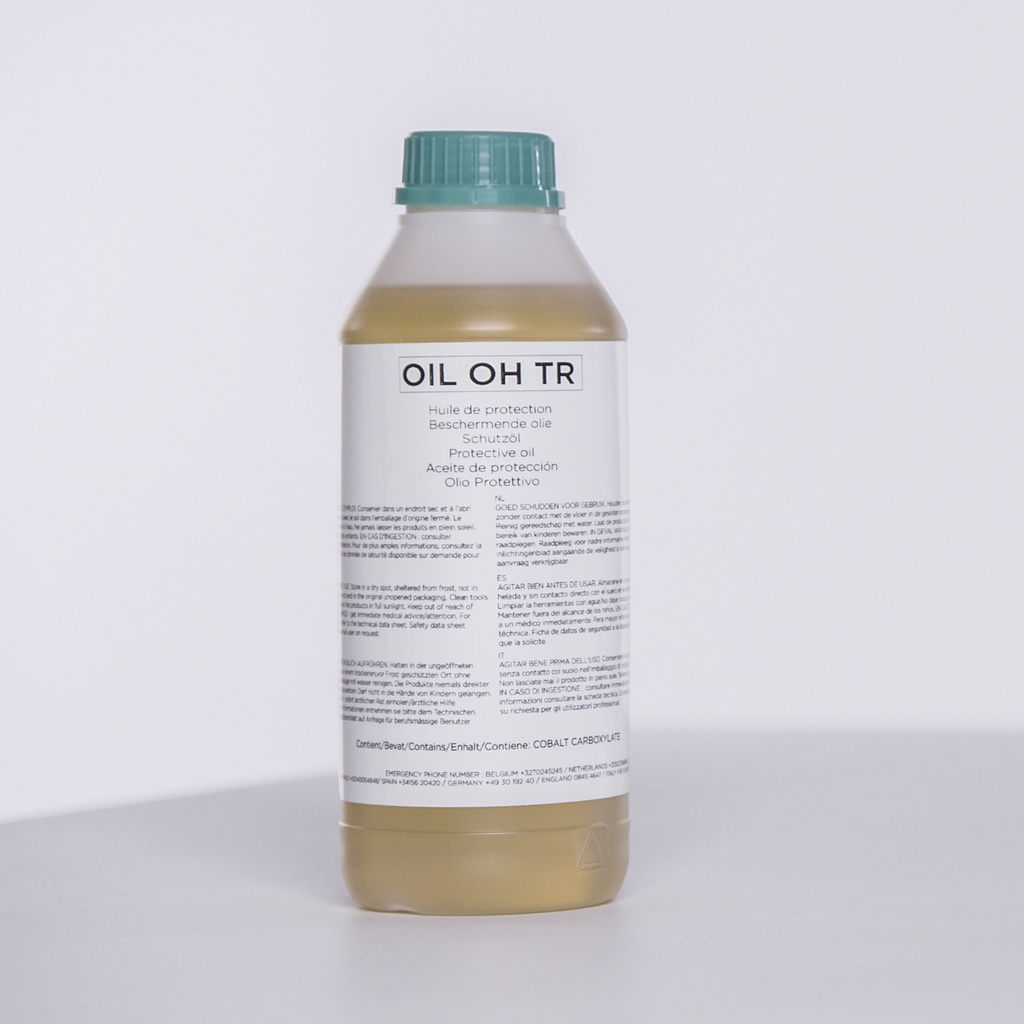
Technical properties
OIL OH TR is a transparent mixture of partially boiled and bleached natural oils, modified with drying and hardening agents, along with water- and grease-repellent additives. Its light color keeps the surface transparent after treatment.
AREAS OF USE
- For indoor and outdoor work.
- For floors, walls, countertops, and bathrooms in residential spaces.
- For the protection of mineral coatings, concrete, wood, and other surfaces.
ADVANTAGES
- Natural composition.
- Nourishes the surface.
- Regenerates.
- Protects.
- Gives shine to the substrate.
- Changes color (enhances the shade).
| Characteristic | Identification data |
|---|---|
| State | Liquid |
| Appearance | Oil |
| Color | Light brown |
| Odor | Specific |
| Apparent density (20°C) | 0.94 kg/l |
| Packaging | 5 l or 1 l net volume containers |
| Storage | 6 months in a dry, frost-protected place, in the original closed packaging, avoiding contact with the ground. Never leave products in direct sunlight. |
| Customs code | 15 18 00 31 |
| Parameter [1] | Usage data |
|---|---|
| Yield | From 100 to 200 ml/m², depending on the porosity of the substrate. |
| Application temperature | Min. +10°C, max. +30°C. |
| Air humidity | Min. 65 %, max. 90 %. It is prohibited to use devices that can dry the air (dehumidifiers, air conditioners) 1 week before, during, and after work. |
| Substrate moisture | < 3 % |
| Drying time (20°C) | Dry to the touch: 1 hour Light movement: after 8 hours Between layers: 1–2 hours Light operation: 72 hours Complete drying: 15 days. |
THE GROUND AND ITS PREPARATION
- The substrate must be sound, dry before and after coating, clean, matte, free of dust and grease.
- It must be hard, non-bouncing, and non-crumbling.
PREPARING THE MIXTURE
Thoroughly mix the different components by shaking the package. Keep this mixture homogeneous throughout the work.
COATING PROCESS
- Soak the surface with a cloth, brush, or roller.
- Collect any excess product with absorbent paper and immediately distribute the remainder with a clean, white cotton cloth.
- Allow the surface to dry evenly until it achieves a matte appearance.
- Repeat this operation at least 3–4 times. Well saturate the substrate.
POLISHING
Once completely dry, polishing with a sheepskin-type disc will provide a satin sheen and distribute the product better on the surface.
OTHER INFORMATION, MAINTENANCE, AND SAFETY
- Tool cleaning: Fresh product is cleaned with lukewarm or hot soapy water.
- Maintenance: Oil-treated surfaces require maintenance without aggressive agents. For cleanliness, use a specially formulated cleaning agent diluted in water.
- Lime removal: Use vinegar diluted in water. Start with a low concentration and increase it depending on the hardness of the water.
- Protection renewal: Apply a new layer of oil with a cloth at least 1–2 times a year, ensuring that all lime residues are removed beforehand.
- Warnings: The work area must be protected from rain, sun, wind, and cold until completely dry. It is highly discouraged to apply on substrates containing salts. The product will change the color of the substrate.
IMPORTANT SAFETY WARNING
Some fabric fibers that come into contact with oil may cause spontaneous combustion. Before disposing of used cloths, soak them in water. This note applies to all vegetable oils. If swallowed, seek medical attention.
LEGAL NOTICE
Recommendations for the final use and application of products are provided in good faith, based on the manufacturer's knowledge under normal conditions. Variations in materials and specific conditions at the site do not provide any other guarantee, except for the statutory warranty for hidden defects. Users must familiarize themselves with the latest version of the relevant product instructions.